- 3D Cameras
- Allied Vision Cameras
- Basler Cameras
- Camera Accessories and Optomechanics
- Gigabit Ethernet Cameras
- High Speed Interface Cameras
- IDS Imaging Cameras
- Imaging Systems
- JAI Cameras
- Line Scan Cameras
- LUCID Vision Labs Cameras
- New Cameras
- NIR Cameras
- Pixelink Cameras
- Teledyne Dalsa Cameras
- Teledyne FLIR Cameras
- Teledyne Lumenera Microscopy Cameras
- Thermal Cameras
- USB Cameras
Sale
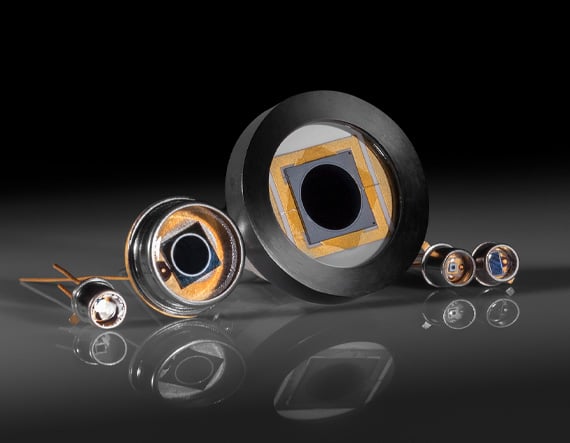
Normal Response, 613.0mm 2 , Silicon Detector
Original price was: $681.80.$68.00Current price is: $68.00.
51
People watching this product now!
Description
Product Details For #53-374 : Housing is larger than standard BNC mount. Maximum housing outer diameter is 1.675″, whereas typical BNC is 0.975″. UV Enhanced, Blue Enhanced, and Normal Response Options Active Areas from <1 to 100mm 2 C-Mount and S-Mount Mounting Solutions Available Through the photovoltaic effect, detectors provide a means of transforming light energy to an electrical current. The root of the theory behind this phenomenon is a small energy gap between the valence and conduction bands of the detector. When light, with enough energy to excite an electron from the valence to the conduction band, is incident upon the detector, the resulting accumulation of charge leads to a flow of current in an external circuit. Since light is not the only source of energy that can excite an electron, detectors will have some amount of current that is not representative of incident light. For example, fluctuations in thermal energy can easily be mistaken for light intensity changes. A variety of these “non-light” contributions are present and, when summed up, make up the total noise within the detector. The ratio of the overall signal output to the noise level is known as the signal to noise ratio (s/n) and can be used to determine if noise will be a concern within a particular application. While noise is certainly a key means of characterizing detectors, it is only one of the characteristics which should be considered when selecting a detector. Different Operation Modes Photovoltaic (Unbiased): During PV operation, no external bias is applied to the photodiode. Since Dark Current is a function of bias magnitude, PV operation eliminates Dark Current as a source of noise. In this case, the NEP will be lower, thereby allowing greater sensitivity at lower wavelengths. This makes it ideal for low signal detection. One disadvantage is the slightly lower responsivity at higher wavelengths (see graph). Photoconductive (Biased): During PC operation, a reverse bias on the photodiode results in a number of response advantages, such as a faster rise time. This makes this type of operation more suitable for high frequency applications. One inconvenience is that the dark current increases with this applied biased current, so noise is introduced into the system. Specifications General Type: Biased Typical Applications: High light levels, pulse detectors, AC light measurement Rise Time (ns): 250 @ -10 V/50 Ω, 632nm Model Number: PIN-25D Note: Normal Response Protective Window: Borosilicate Package: BNC Physical & Mechanical Properties Active Area (mm 2 ): 613.0 Construction: PIN Outer Diameter (inches): 1.675 Length of Leads (inches): BNC Optical Properties Detectivity (cmHz 1/2 /W): 2.25 x 10 13 @ -10 V, 970nm Electrical Terminal Capacitance (pF): 9500 @ 0 V; 1800 @ 10 V Voltage Bias, V Bias (V): -10 Responsivity @ 970nm (A/W): 0.65 Noise Equivalent Power NEP (W/ Hz 1/2 ): 1.1 x 10 -13 Maximum Breakdown Voltage (V): 30.00 Dark Current I d (nA): 15 @ 10V Environmental & Durability Factors Operating Temperature (°C): -10 to 60 Regulatory Compliance Certificate of Conformance: View ×
Additional information
| Type | |
|---|---|
| Note | |
| Active Area (mm 2 ) | |
| Package |